
Why BI Analytics Pipelines Are Often Safer Than Excel for Accounting Firms
3 MIN READ
DECEMBER 9, 2025
JESSICA KENTCH, FOUNDING PARTNER, ABLAZE ANALYTICS & COLLECTIVE
For many accounting firms, the idea of building centralized BI analytics pipelines can feel risky.
Client financial data flowing out of QuickBooks or Xero.
Dashboards sitting outside the general ledger.
Partners worrying about liability, accuracy, and trust.
Ironically, the bigger risk is often doing nothing at all.
Most firms still rely on spreadsheets stitched together with manual exports, emailed files, and locally saved workbooks. These workflows feel familiar — but from a risk perspective, they are often far more dangerous than a properly governed analytics environment.
The uncomfortable truth: Excel feels safe because it’s familiar
Excel has been the backbone of accounting workflows for decades. It’s flexible, fast, and universally understood. But familiarity has masked some serious operational risks that many firms now accept as “normal.”
Manual exports.
Copy-paste logic.
Files stored on desktops or shared drives.
No visibility into who changed what, when, or why.
These risks don’t show up until something breaks — and when they do, firms realize how fragile their processes really are.
Excel vs centralized BI analytics: a risk comparison
When you look at analytics through a risk and governance lens, the difference is stark.
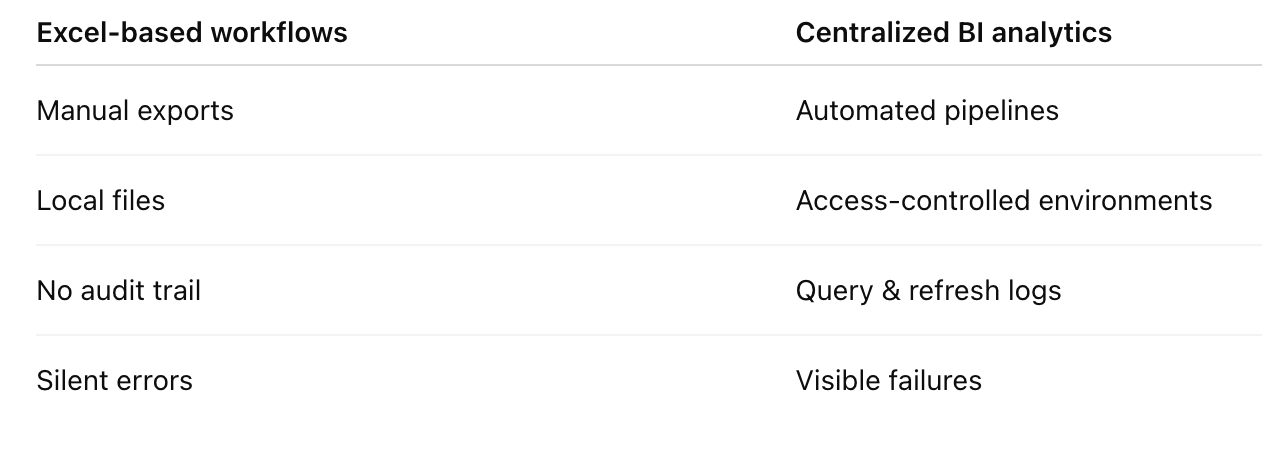
Dashboards don’t increase risk — they expose it
This is the part many firms get backwards.
Dashboards don’t create inaccuracies. They surface existing ones.
They force firms to confront questions that spreadsheets often hide:
What exactly does this metric mean?
Where does this number come from?
How fresh is the data?
Who owns this definition?
That discomfort isn’t risk — it’s accountability.
When implemented properly, BI analytics reduce:
Key-person dependency
Manual processing errors
Inconsistent client reporting
Version-control chaos
They replace “tribal knowledge” with shared understanding.
The real risk isn’t technical — it’s cultural
Most BI analytics initiatives in accounting don’t fail because of security breaches or bad infrastructure.
They fail because of how they are positioned internally.
The biggest problems usually look like this:
Dashboards oversold as “financial truth”
When dashboards are positioned as the books instead of decision-support tools, tension is inevitable. BI analytics should inform conversations — not replace formal review, reconciliation, or judgment.
No partner education
If partners don’t understand:
What data is included (and excluded)
How often it refreshes
What assumptions exist
They won’t trust it — or worse, they’ll misuse it.
No internal data ownership
If no one owns metric definitions, dashboards become political. Different teams build different “truths,” and confidence erodes quickly.
No standard definitions
“Revenue,” “cash flow,” and “margin” mean different things depending on context. Without documented definitions, dashboards magnify confusion instead of clarity.
Firms that fail treat BI analytics as a tool.
Firms that succeed treat BI analytics as a practice capability.
When BI analytics is not appropriate
BI analytics pipelines are not a silver bullet — and they can create conflict when misused.
They are risky when:
The firm wants to shortcut financial review
No one owns data definitions
Clients expect audit-level precision from dashboards
The firm has zero appetite for process change
In these environments, dashboards don’t reduce friction — they expose it.
BI analytics amplify existing maturity (or lack of it). They do not fix governance problems on their own.
The right way to position BI analytics in an accounting firm
BI analytics works best when it is clearly framed as:
Advisory insight, not attestation
Operational visibility, not formal reporting
Near real-time context, not closed books
Client conversation support, not guarantees
When positioned this way, BI analytics platforms become powerful enablers — not liabilities.
Why modern firms are leaning in anyway
Despite the hesitation, more firms are adopting BI analytics because the upside is hard to ignore.
Used correctly, BI analytics pipelines are:
✅ Advisory accelerators
They allow firms to move faster from numbers to insight.
✅ Client-retention levers
Clients who understand their data — in context — stay longer.
✅ Scalable insight engines
The same logic can serve 10 clients or 1,000 without rebuilding from scratch.
Most importantly, BI analytics free senior talent from spreadsheet plumbing and refocus time on judgment, strategy, and storytelling.
Bottom line
BI analytics pipelines for accounting firms are not inherently risky.
They become risky only when they are:
Positioned incorrectly
Governed poorly
Used outside their intended scope
When done right, BI analytics is often safer than Excel — not because the technology is perfect, but because it introduces visibility, discipline, and accountability where silent risk used to live.
They are not replacements for accounting.
They are a force multiplier for modern CPA and CFO practices.